English (UK)
  Македонски
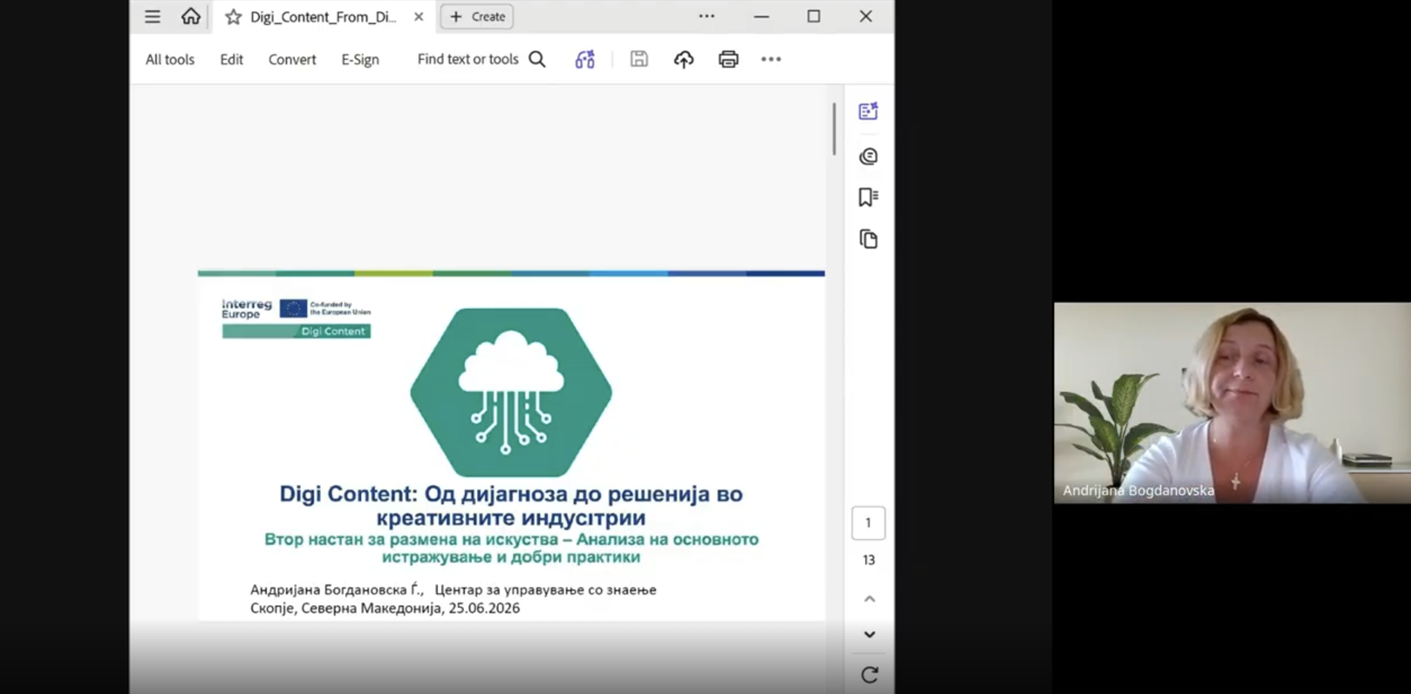
The digital transformation of the Creative and Content Industries (CCI) is rapidly accelerating, and North Macedonia is taking strategic steps to keep pace.
On June 25, 2026, the Center for Knowledge Management (CKM)—acting as the Discovery Partner for the European Interreg project "Digi Content"—hosted its second regional stakeholder meeting. The broader Digi Content project is dedicated to helping regions improve digital skills and create new opportunities in the creative sectors through the use of Artificial Intelligence (AI) and Virtual Reality (VR).
Chaired by Andrijana Bogdanovska, the online meeting brought together key representatives from local universities, IT companies, educational centers, and public authorities. The session focused on interpreting the findings of the recent Baseline Survey and discussing how to successfully integrate advanced technological infrastructure within local creative ecosystems.
The Baseline Reality: High AI Adoption vs. XR Barriers
Data from the Digi Content Baseline Survey reveals a dynamic, yet fragmented, local landscape. North Macedonia’s creative workforce is highly flexible and project-oriented, with 70% of surveyed organizations relying heavily on volunteers, seasonal staff, or project-based teams.
When evaluating technological expertise, a stark contrast emerges. The local ecosystem shows a remarkably high level of AI adoption, with multiple organizations reporting advanced expertise and actively using AI to deliver services, automate processes, and conduct research. However, practical expertise in Extended Reality (XR) technologies—such as Augmented Reality (AR) and Virtual Reality (VR)—remains quite low.
Stakeholders identified a lack of funding and inadequate technological infrastructure as the absolute top barriers to adopting XR. Local participants noted that XR hardware is currently too expensive and commercially difficult to sustain in a smaller market without external support.
Looking to Europe: Good Practices and Solutions
As a Discovery Partner, CKM’s role is to evaluate successful European innovation models and transfer these insights to North Macedonia. To address the local barriers of high infrastructure costs and skills gaps, several European "Good Practices" were highlighted during the meeting:
Shared Infrastructure (Poland): To bypass the high costs of individual XR equipment, stakeholders looked at the DIGI Lab at the Coal Mining Museum in Zabrze. This lab acts as a centralized hub, utilizing shared 3D scanning and VR equipment to digitalize industrial heritage.
Business & Management Skills (Lithuania): Recognizing that technical skills alone are not enough to sustain a business, Lithuania’s GameTech Accelerator was presented as a successful model for specifically improving the digital business management and development capabilities of creative startups.
Democratizing Tech via Regional Hubs (Portugal): The partnership between Startup Leiria and the Museum of Leiria demonstrated how integrating tech startups directly into cultural and public spaces can democratize access to expensive technology for smaller creative entities.
Building a Resilient Creative Ecosystem
Moving from diagnosis to solutions requires actionable strategies. During the session, Andrijana Bogdanovska emphasized that successfully integrating AR, MR, VR, and AI requires robust engineering infrastructure and structured ecosystem management.
The discussions highlighted the necessity of implementing best practices to foster organizational growth and emphasized the immense value of international collaboration. Specifically, stakeholders explored policy instruments and partnership structures—such as those connecting Macedonia and Portugal—designed to support joint exhibition initiatives. Moving forward, a strategic focus will be placed on integrating mediums like photography and virtual reality into broader organizational efforts to enhance cultural tourism and media production.
By bridging the gap between agile tech startups, academic institutions, and public authorities, North Macedonia is actively laying the groundwork for a more competitive, sustainable, and innovative digital creative sector.